BLOG • SEO SERVICES
How Long Does SEO Take to Work? Realistic Timelines for Small Businesses
Every owner asks this question before signing anything. You pay for work you cannot see yet. You want a date, not a vague promise. An honest answer gives you a range and reasons.

Table of Contents
This guide gives you both parts. You will see a month-by-month timeline below. You will also see timelines for three starting points. New sites, established sites, and local firms differ.
No honest provider can promise page one by Friday. Google gives no fixed number for rankings. Its SEO Starter Guide says some changes take effect in a few hours, while others could take several months. Your market and starting point decide your place inside it.
Quick answer: Most small businesses see early movement in three to six months. Strong traffic and leads often take six to twelve months. New sites sit at the slow end. Established and local sites often move sooner.
SEO timelines at a glance:
- Why SEO takes time at all
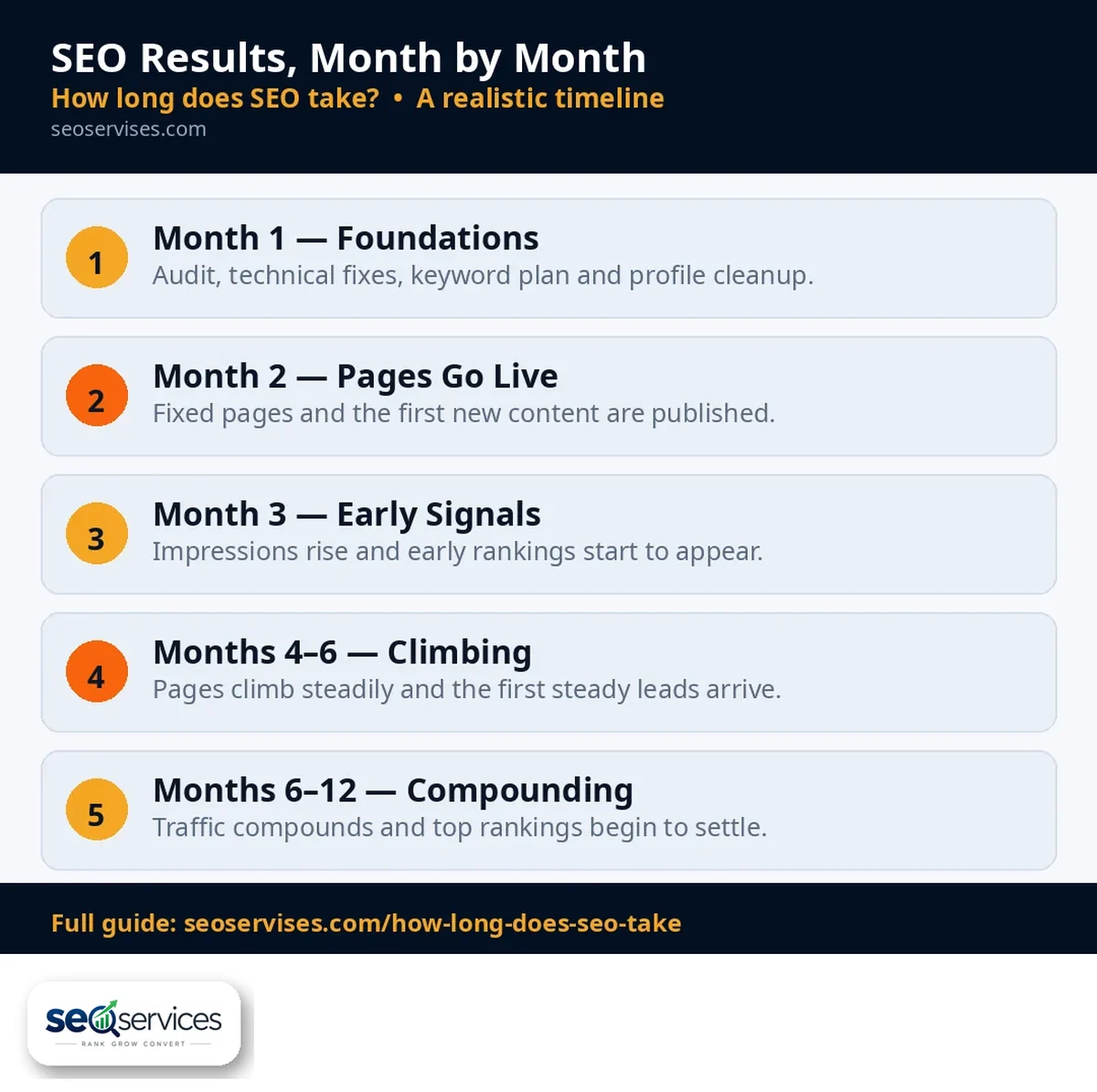
- A month-by-month results timeline
- Timelines for new and established sites
- How local SEO timelines differ
- Factors that speed up or slow down results
- Signs your SEO is actually working
- What to do when nothing moves
Why SEO Takes Time at All
Google does not rank a page at publish time. It must find the page first. Then it crawls and reads the page. Next it compares the page with rivals. Only then does it choose a position.
Trust also builds in small steps. A new site has no history at all. It has few links and few reviews. Each good page adds a little proof. Each real mention adds a little more.
Rankings also bounce while Google tests pages. A page may reach page one, then drop. That testing settles over weeks, not days. Early movement is a signal, not a finish line.
Paid ads work in a very different way. Ads show the hour you fund them. SEO builds an asset that compounds slowly. That contrast shapes every timeline in this guide.
Table 1: A Month-by-Month SEO Timeline
| Month | What usually happens |
|---|---|
| Month 1 | Audit, fixes, keyword plan, and profile cleanup |
| Month 2 | Fixed pages and first new content go live |
| Month 3 | Impressions rise and early rankings appear |
| Months 4 to 6 | Pages climb and first steady leads arrive |
| Months 6 to 12 | Traffic compounds and top rankings settle |
Month one rarely shows traffic growth at all. The work is mostly repair and planning. Your team fixes crawl and indexing problems first. They also map keywords to the right pages.
Month two turns plans into live pages. Titles, content, and internal links improve together. Google needs time to recrawl those changes. Owners often see nothing change yet.
By month three, early signals should appear. Search Console impressions usually rise first. A few pages may reach page two. Those small signs confirm Google is responding.
Can SEO show results in 30 days?
Rarely, and only in narrow cases. Fixing a technical fault can free quick movement. An established site may gain from title changes fast. New sites almost never rank well in thirty days. Anyone promising that outcome is selling a story. Treat thirty days as setup time, not proof time.
How Long for a Brand-New Website?
A new site starts with zero trust signals. Google has no link history for it. It has no review history for it either. Every signal must be built from scratch.
Expect first rankings inside two to four months. Those ranks usually cover long, specific phrases. Meaningful traffic often needs six to nine months. Competitive markets can push that past twelve months.
Your first wins will look modest on paper. A service page may rank for one town. A guide may earn its first few clicks. Those wins matter because they compound. Each one supports the next page you publish.
Publish fewer pages, but make each one strong. Ten thin pages build trust very slowly. Three strong pages build it much faster. Add internal links between them from day one.
How long does SEO take for a brand-new website?
Plan on six to twelve months for real results. Google must learn that your site is legitimate. It watches content, links, and user response over time. Low-competition towns can move a little sooner. Busy city markets take the full window, often longer. Budget and patience should match that honest range.
How Long for an Established Website?
An established site already holds trust and history. Google knows its pages and its topic. Changes on such sites register much faster. Owners often see movement inside three months.
Fixes can produce the earliest wins here. A blocked page can recover within weeks. A weak title can gain clicks quickly. A merged duplicate can settle in one cycle.
Growth still takes steady work after fixes. New content must target real search demand. Links must grow at a natural pace. Most established sites see strong gains by month six.
The risk for older sites is neglect. Rivals publish while your pages age quietly. Old facts and old prices hurt trust. A refresh plan keeps hard-won rankings safe.
Set monthly checkpoints before the work begins. Write down current impressions, rankings, and call volume. Compare each new month with that starting record. Small gains become easy to spot that way. Without a baseline, owners judge by feel alone. Feelings swing with one slow week. Records stay calm and show the true trend. Share the checkpoint list with anyone doing the work. It keeps every report honest and simple.
How Local SEO Timelines Differ
Local work often moves faster than national work. Your rivals are firms in your town. That pool is smaller and often weaker. Google Business Profile work shows results early.
Profile fixes can change calls within weeks. Correct hours, services, and categories help fast. Fresh photos and steady reviews help too. Map pack movement often follows in two months.
Organic local rankings take a little longer. Service and city pages need content depth. They also need links and review support. Plan on three to six months for stability.
How long does local SEO take to show results?
Most local firms see early movement in six to twelve weeks. That range fits low-competition towns and trades. Busy city markets often need three to five months. Full, stable results can take six months. Review pace and profile accuracy shape the speed. Keep both steady and movement usually follows.

Table 2: What Speeds SEO Up or Slows It Down
| Speeds results up | Slows results down |
|---|---|
| Clean technical health from the start | Blocked pages and crawl errors |
| Strong existing domain history | Brand-new domain with no links |
| Steady, helpful content publishing | Thin pages published in bursts |
| Reviews arriving every month | No review system at all |
| Low local competition | Many strong city rivals |
Budget size plays a smaller role than owners expect. More budget buys more content each month. It also buys faster technical repair work. It cannot buy Google instant trust, though.
Consistency beats short bursts of heavy spending. Three steady months beat one frantic month. Google rewards sites that keep improving over time. Gaps in work often stall early momentum.
Does paying more make SEO work faster?
Only up to a clear point. Extra budget buys more pages, links, and fixes. Those inputs can shorten the early phases. Trust still accrues over months of evidence. No fee removes that waiting period entirely. Spend for steady output, not for promised speed. That mindset protects both budget and expectations.
Signs Your SEO Is Actually Working
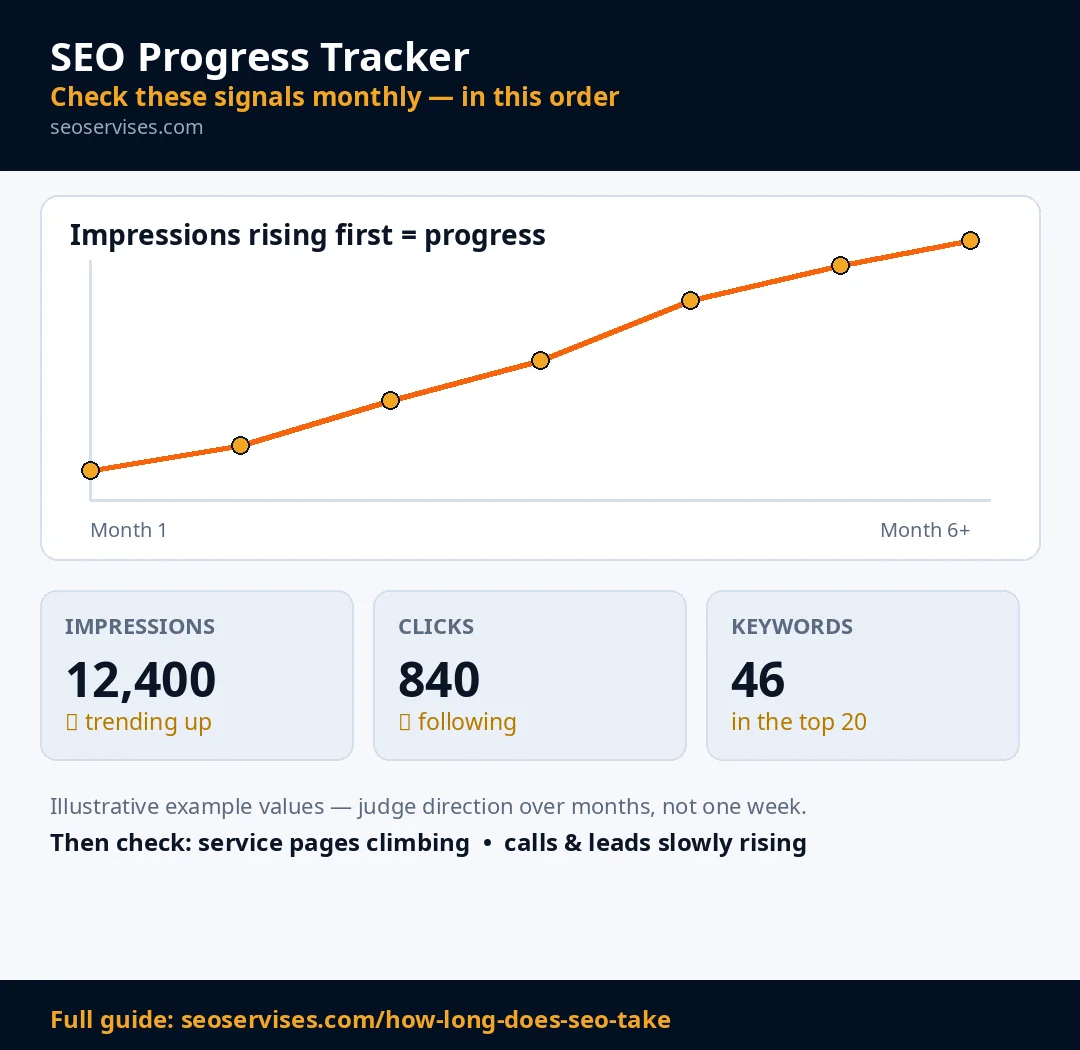
Traffic is the last signal to move. Earlier signals tell you progress is real. Watch impressions in Search Console each month. Rising impressions mean Google shows you more often.
Watch the number of ranking keywords too. New phrases should appear every month. Many will start on page three or four. Their steady climb predicts later traffic growth.
Watch page-level movement on money pages. A service page rising five spots matters. It matters more than a blog traffic bump. Calls and quote requests confirm the trend.
How do I know if my SEO is actually working?
Check four signals in order each month. First, impressions should trend upward over time. Second, more keywords should enter the top twenty. Third, key service pages should climb steadily. Fourth, calls and form leads should slowly rise. Flat lines on all four after four months signal trouble. One rising line usually means patience is working.
What to Do When Nothing Moves
Start by checking the basics, not the strategy. Confirm your key pages are indexed. Confirm no settings block Google from crawling. Many stalled sites hide one simple fault.
Next, judge the content against ranking rivals. Open the top three results for your phrase. Compare depth, clarity, and local proof honestly. Thin pages rarely outrank strong pages for long.
Then review the timeline with clear eyes. Four months of flat impressions needs action. Four months of rising impressions needs patience. The data tells you which case you face.
Choosing help at this point needs care. Google’s guide on hiring an SEO lists questions to ask. Use it before you sign any new contract. Good answers sound specific, never grand or vague.
Cost questions belong in that same review. Our breakdown of how much SEO costs shows normal ranges. It helps you judge quotes against real work. Fair pricing pairs with fair timelines, always.
Channel choice also affects your expectations. Our comparison of local SEO versus Google Ads explains both speeds. Ads rent attention, while SEO builds it. Many firms run both during the early months.
Ready to Set a Timeline You Can Trust?
Honest timelines protect your budget and your patience. Most firms quit right before results compound. A clear month-by-month plan prevents that mistake. You will know what progress should look like.
Our team builds those plans for small businesses. Start at our homepage to see how we work. Then contact us for a timeline built around your market. Tell us your town and your main service.
Frequently Asked Questions
Why does SEO take so long?
Google must crawl, judge, and test your pages. It compares them with pages holding years of proof. Trust signals like links and reviews build slowly. New evidence arrives one page at a time. That process protects users from spam and shortcuts. It also means real work needs months to show.
How long does SEO take for an established website?
Most established sites see movement in three to six months. Existing trust and links shorten the early phases. Technical fixes can show gains within weeks sometimes. Strong traffic growth often lands by month six. Neglected sites take longer than maintained ones. A quick audit reveals your true starting point.
What should I see in the first three months?
Expect rising impressions before rising traffic. Expect new keywords entering lower positions first. Expect fixed pages to get recrawled and rejudged. A few pages may reach page two by month three. Calls usually grow later than these signals. Judge month three on direction, not revenue.
Should I stop SEO once I rank well?
No, stopping usually starts a slow slide. Rivals keep publishing and earning links monthly. Google also favors fresh, maintained pages over time. You can reduce spend after strong rankings arrive. Keep reviews, updates, and basic checks going, though. Maintenance protects the asset you paid to build.
How long should I commit to SEO before judging it?
Give any fair program at least six months. Judge early months on impressions and rankings. Judge later months on traffic and leads. Twelve months shows the full compounding effect clearly. Short trials favor luck over real skill. A written timeline makes that judgment much easier.
Does posting more content speed up results?
Only when each new page adds real value. Steady publishing builds topical depth and trust. Bursts of thin posts can dilute your site. One strong guide beats five weak ones. Match each page to one clear search intent. Quality and consistency set the pace together.