BLOG • LINK BUILDING
How to Find Competitor Backlinks and Ethically Copy Their Best Links
Your rivals rank above you for a reason. Part of that reason sits on other websites. Those sites link to your rivals and not to you. That gap is research you can run today.

Table of Contents
This post covers the research step only. It shows you where rival links come from. It also shows which links deserve your time. Building and earning those links comes next.
Our earlier guide covers the building tactics themselves. This post stops before outreach begins. Cleanup of bad links is a separate job too. Here, you learn to build one clean target list.
Learning how to find competitor backlinks is a skill. It is not a purchase you must make. You do not need a paid tool suite. Three free checkers cover most small sites. One shared sheet pulls their results together. The workflow below takes about one focused hour.
Quick answer: Pick three to five search rivals first. Run each rival through three free backlink checkers. Merge every result into one spreadsheet. Keep links that two or more rivals share. Drop spam, paid placements, and irrelevant sites. That short list is your ethical copy list.
Competitor backlink research at a glance:
- Pick the rivals who outrank you in search
- Run each rival through three free checkers
- Merge all results into one spreadsheet
- Find domains linking to several rivals
- Sort links into copy, adapt, and skip
- Vet each target before any outreach
Start With the Right Competitors
Your search rivals are not always business rivals. A firm across town may never rank online. A firm across the state may outrank you daily. Study the sites Google rewards, not just nearby shops.
Search your main service plus your city. Note the five sites on page one. Repeat that search for two more services. Names that appear again and again matter most. Those repeat names form your research list.
Check your own ranking keywords too. Tools show which sites share your keyword set. Rivals just above you are the best targets. Their link profiles are strong but still reachable. Giant national brands teach less useful lessons.
Keep the list short and focused. Three to five rivals give plenty of data. Ten rivals bury you in raw rows. You need a list you can act on. Quality of targets beats volume of data.
How can I see a competitor’s backlinks for free?
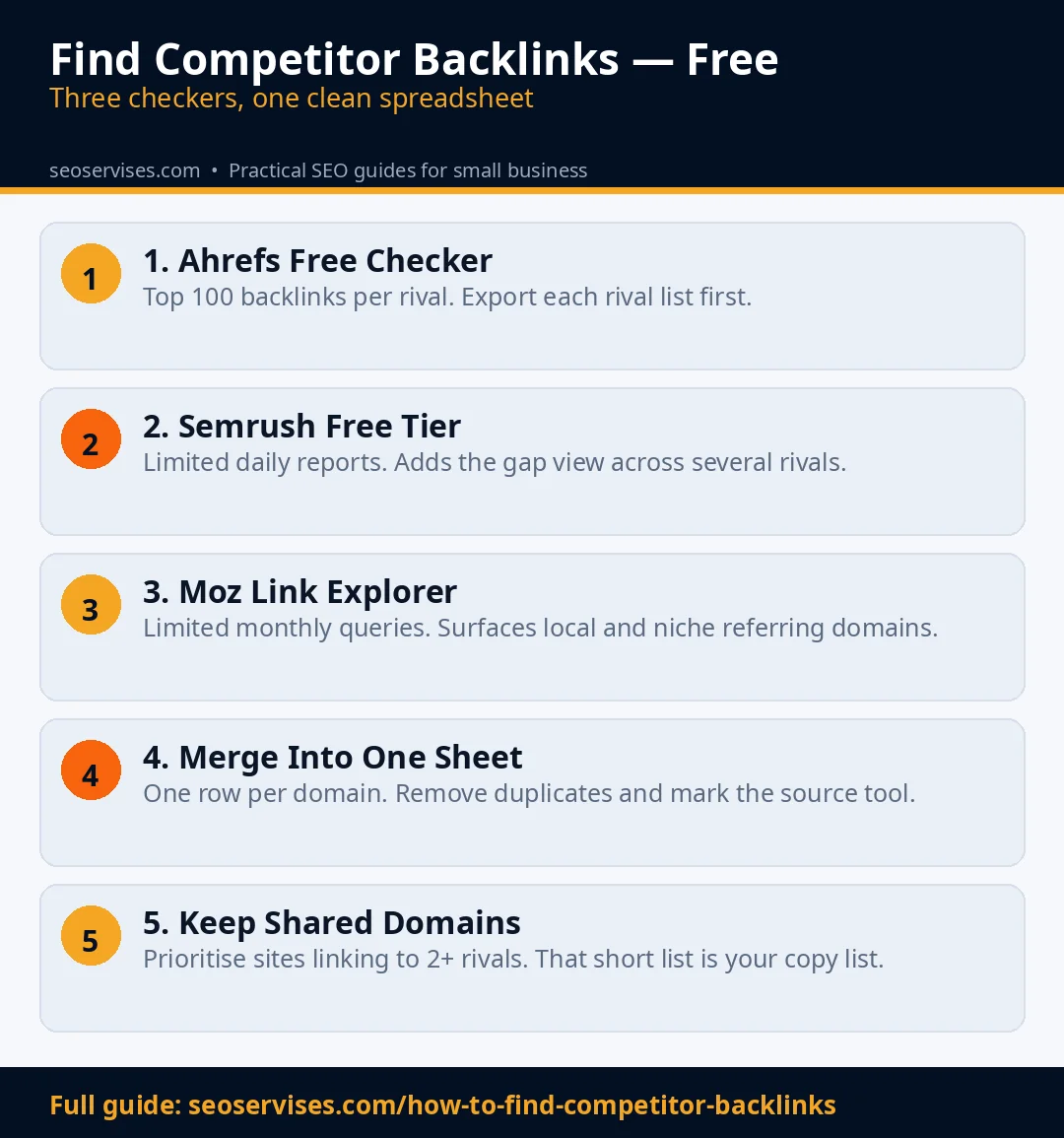
Use the free checker from Ahrefs first. It shows the top 100 backlinks for any domain. Add the free tier of Semrush next. Then check Moz Link Explorer for more rows. Each tool holds a different link index. Together they show far more than one alone. No card or paid plan is needed.
The Free-Tool Stacking Workflow
Each backlink tool crawls the web alone. Each one finds links the others miss. One tool gives you a partial picture only. Three tools give a picture worth trusting. Stacking them is the core of this method.
This is how to find competitor backlinks without paying. Start with the Ahrefs free backlink checker. Enter one rival domain and export the list. Note the referring domains and anchor text. Save the file with the rival name. Repeat the step for every rival.
Move to the Semrush free tier next. Run the same rival through its backlink report. Export what the free limit allows you. Add those rows to your working file. Mark the source tool for each row.
Finish with Moz Link Explorer. Its free queries show fresh referring domains. Moz often surfaces local and niche sites. Those small sites matter for local firms. Add any new domains to the file.
Merge Everything Into One Sheet
Raw exports from three tools overlap heavily. One domain may appear six times. Your sheet needs one row per domain. Cleaning the data is simple, steady work. It turns noise into a clear target list.
Create columns for the basics first. Use domain, linking page, and target page. Add anchor text and a quality note. Add one column per rival as well. Tick which rivals each domain links to.
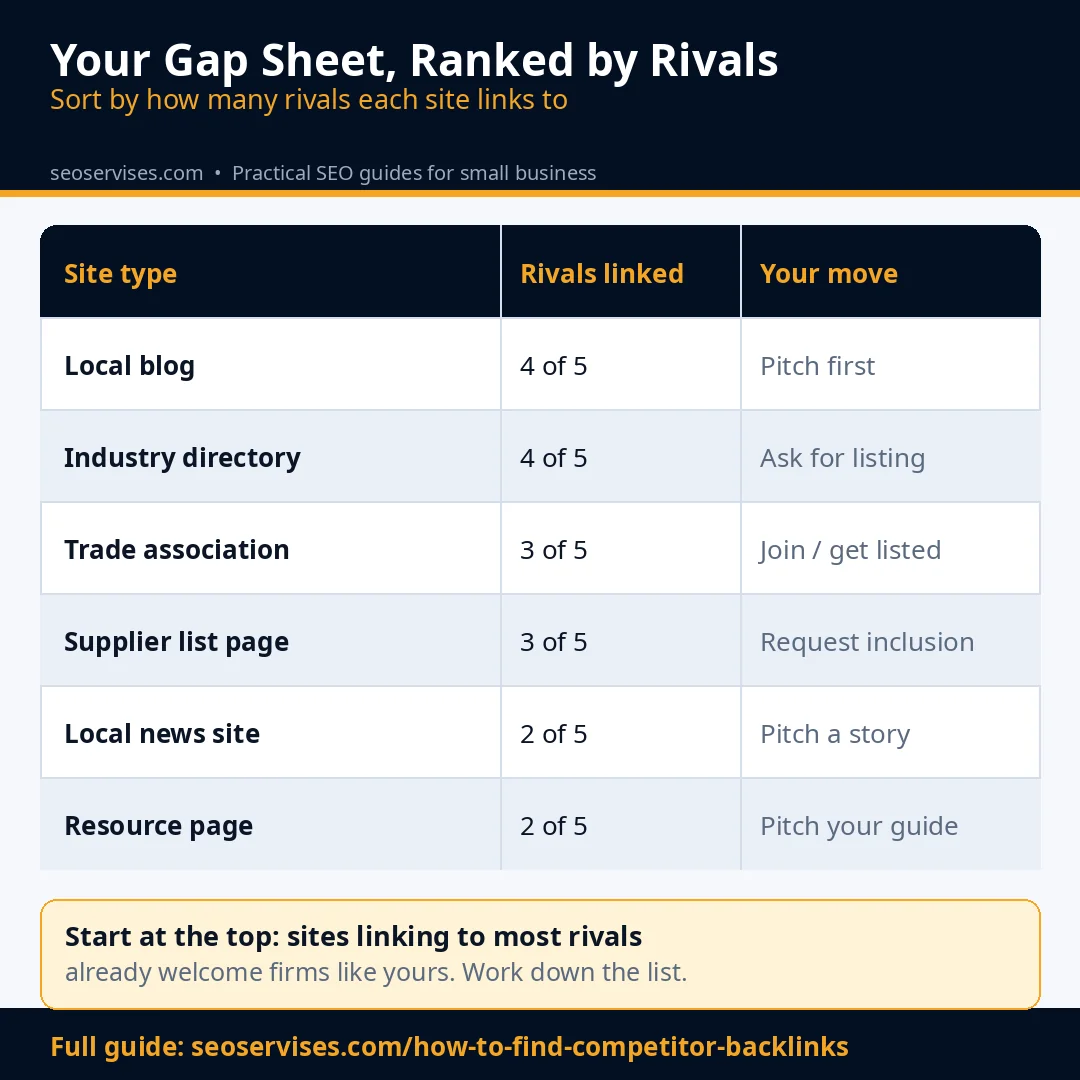
Remove duplicate rows by domain name. Keep the strongest linking page as your example. Sort the sheet by rival count next. Domains linking to three rivals sit on top. Domains linking to one rival sit lower.
This sorted view is your gap list. It shows links your market already gives. Those sites clearly link to firms like yours. That proof makes them your best prospects. It also keeps your outreach honest and focused.
How many competitors should I analyze?
Three to five rivals work for most small firms. Fewer rivals can hide shared link patterns. More rivals add rows without adding insight. Pick rivals who rank just above you. Add one stronger leader for stretch targets. Stop when new rivals repeat the same domains. That repeat point means your list is complete.
Sort Links Into Copy, Adapt, and Skip
Not every rival link deserves a copy attempt. Some links come from years of brand history. Some come from paid deals you must avoid. Sorting protects your time and your site. Use three plain buckets for every row.
Copy links are open to firms like yours. Local directories and trade groups fit here. Supplier lists and event pages fit too. Resource pages in your trade also fit. Anyone qualified can earn these same links.
Adapt links need your own version first. A rival guide earned links from many blogs. You cannot copy that guide or its links. You can publish a better guide instead. Then pitch the same sites your fresh take.
Skip links carry risk or no real value. Paid posts and link networks belong here. Random foreign blogs belong here as well. Comment spam and footer links belong here. Copying those patterns can harm your site.
Table 1: The Free Tools and What Each Adds
| Tool | Free access | Best use in this workflow |
|---|---|---|
| Ahrefs Backlink Checker | Top 100 backlinks per domain | First pass on any rival |
| Semrush Backlink Analytics | Limited free reports daily | Gap view across several rivals |
| Moz Link Explorer | Limited free queries monthly | Local and niche referring domains |
| Google Search Console | Free for your own site | Your own links, for comparison |
Table 2: Sorting Rival Links Into Three Buckets
| Bucket | What it looks like | Your move |
|---|---|---|
| Copy | Directory, supplier, or group listing | Ask for your own listing |
| Adapt | Rival guide cited by many blogs | Publish a better guide, then pitch |
| Skip | Paid post or unrelated bulk link | Drop it and note the pattern |
Is it legal to copy competitor backlinks?
Studying public link data is normal research. Every tool above sells that exact service openly. The line sits at copying content or deals. Never copy a rival page word for word. Never join a paid scheme they used. Earn your own link from the same site. That path is both legal and safe.
Google draws its own clear line too. Its link spam policies ban paid ranking links. They also ban large link schemes and networks. Research stays fine under those rules. Copying the tactic, not the target, causes trouble.
Check Quality Before You Copy Anything
A shared link is a lead, not a verdict. Some sites link to every rival badly. Check each target with four quick tests. Five minutes per site saves months of cleanup. Bad links are far easier to avoid.

First, check fit with your trade and town. A home services blog fits a plumber well. A general news blog can also fit. A casino or loan blog never fits. Relevance is your strongest quality signal.
Second, check for real readers and content. Search the site name and a post title. Real sites rank for their own topics. Look for named authors and recent dates. Ghost sites show none of those signs.
Third, scan who else the site links to. Pages linking to spam topics warn you early. One odd link may be an old mistake. A pattern of odd links means walk away. Your link would sit in poor company.
Fourth, check the link type rivals received. Editorial mentions inside articles carry real weight. Listings carry steady local value over time. Sidebar and footer links carry far less. Match your effort to the likely reward.
Some rival links will look plain toxic. Leave those out of your copy list. Our full guide to toxic backlinks shows removal steps. Read it before you touch any cleanup work.
What makes a competitor backlink worth copying?
The linking site serves readers in your trade. The page earns real visits and engagement. The link sits inside useful, relevant content. The site links to several of your rivals. Other firms can earn the same placement fairly. Those five signs mark a target worth pitching. One sign alone is not enough proof.
Turn Your Gap List Into an Outreach Plan
You now know how to find competitor backlinks step by step. Your sorted sheet is now a work plan. Rank targets by rival count and fit. Start with copy bucket rows first. Those asks are simple and often free. Early wins build habit and confidence fast.
Note the contact path for each target. Some sites use a form or email. Some list rules for new submissions. Follow their stated rules exactly every time. Editors reward firms that read the guidelines.
Set a weekly pace you can hold. Five careful pitches beat fifty rushed ones. Track each pitch and reply in your sheet. Note dates so follow-ups stay polite. One follow-up after a week is enough.
When a target needs content from you, plan it. That is where real link building begins. Our guide on how to build backlinks for a small business covers those tactics. It walks through outreach, assets, and local partnerships. Use this research list as its input.
Set a Target Number Before You Build
A gap list raises one natural question. How many of these links do you need? Raw rival totals can mislead you badly. One rival may hold hundreds of weak links. Your target should reflect quality, not bulk.
Start with the shared domains only. Count links held by two or more rivals. That count is your first realistic goal. It grows as your own profile grows. Review the count again each quarter.
Our companion guide on how many backlinks do you need explains target setting. It shows how to benchmark page one fairly. Read it before you set monthly goals. It keeps this research grounded in honest numbers.
How often should I check competitor backlinks?
Run a full check once each quarter. That pace catches new rival campaigns early. It also fits the free tool limits well. Check sooner after a rival redesign or launch. New links often follow big site changes. Between checks, watch your own new links monthly. Small, steady reviews beat rare, huge audits.
When Research Shows a Bigger Gap
Sometimes the gap is wider than time allows. A rival may hold links from years of PR. Your team may lack hours for outreach. The research still pays off in that case. It shows exactly what good would look like.
Hand the sheet to whoever runs your links. Clear data makes their work faster and safer. Our off-page SEO services start from this same research. We vet every target before any pitch goes out. You approve the list before work begins.
Ready to Close Your Link Gap?
Your rivals already showed you the map. Their best links sit on sites open to you. Free tools and one sheet reveal them. Sorting and vetting keep the plan safe.
Start with three rivals this week. Build the merged sheet and sort it. Pitch the five easiest targets first. Small wins here compound into real rankings.
Contact us if you want the research done for you. Tell us your main service and town. We will return a vetted target list.
Frequently Asked Questions
What is a backlink gap analysis?
It is the formal name for this research. It compares rival link profiles with your own. The gap is domains linking to rivals, not you. Tools like Link Intersect automate that comparison. A merged sheet does the same job free. The result is a ranked list of prospects. Those prospects already link to firms like yours.
Do free backlink checkers show every link?
No free checker shows a full link profile. Each tool indexes only part of the web. Free tiers also cap rows and exports. Stacking three tools closes most of the gap. The shared domains matter more than total counts. For a small site, that coverage is enough.
Can I copy every link a competitor has?
No, and you would not want to copy all. Some links come from brand history or ownership. Some come from paid deals that break rules. Others point to content you do not have. Copy the open, relevant, earned placements only. Adapt the rest or leave them alone.
What if a competitor has far more links than me?
Do not chase their raw total at all. Focus on domains linking to several rivals. Those sites prove they welcome your trade. Win ten of those before counting totals again. Quality and fit close ranking gaps faster. Bulk weak links rarely hold their value.
Should I study big national brands too?
Study them last, and only for ideas. Their links come from scale you cannot copy. Press coverage and brand searches drive their profile. Your page-one rivals teach reachable tactics instead. Add one leader only as a stretch view. Keep your working list local and realistic.